
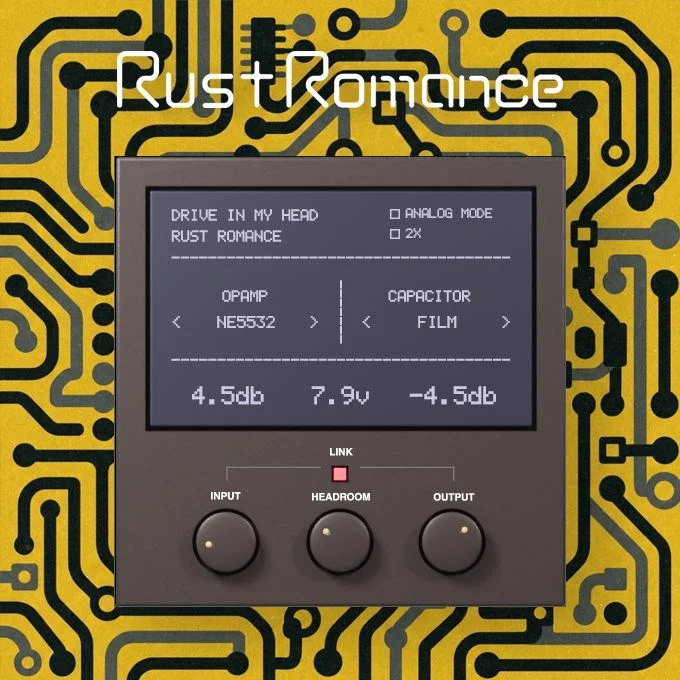
Drive in my head
Key Features
- Physically modeled op-amp line-driver circuit for subtle analog-stage coloration
- Fifteen op-amp and amplifier characters, including hi-fi, discrete, cheap, and OTA-style models
- Five coupling capacitor modes for direct, clean, vintage, softened, or aged top-end behavior
- Analog Mode adds slow rail ripple and input offset movement for less static tone
- 2X mode runs two linked circuit stages in series when the character needs to be more audible
- Automatic output level compensation helps compare tone changes without loudness bias
Description
Drive in my head is a circuit-modeled saturation plugin built around op-amp line-driver behavior rather than obvious fuzz or clipping. It puts clean sources through a modeled amplification stage so virtual instruments, sample-based drums, synths, and DI-style parts can feel less flat in a mix.
The main tone control is the op-amp selection, with fifteen modeled devices ranging from studio-standard NE5532 and TL072 chips to rougher LM358, LM741, TDA2030, CA3080, and LM13700 characters. Five coupling capacitor options then shape the output stage, moving from direct and transparent to rolled-off, aged, and consumer-electronics-style color.
Analog Mode adds slow rail ripple and input offset drift, while 2X runs the same op-amp and capacitor stage twice in series for a stronger version of the same coloration. Automatic output compensation helps keep level changes from disguising the tonal effect.
This is best approached as a subtle analog placement tool, not a one-knob distortion box. It rewards small moves on sources that are already close but need more weight, top-end behavior, or old-hardware texture before they sit naturally.
Frequently Asked Questions
Is Drive in my head meant for heavy distortion?
No. Rust Romance positions it as an op-amp line-driver model for subtle analog character, not as a fuzz or aggressive overdrive effect. It can move into lo-fi territory when pushed, but its core use is tone, weight, and placement.
What changes when you switch op-amp models?
Each op-amp is modeled from data-sheet-inspired behavior and topology, so changing models affects weight, thickness, top-end feel, and saturation response. The list includes cleaner studio standards as well as rougher older or budget-device characters.
What do the capacitor options add?
The coupling capacitor stage changes the output coloration after the op-amp. Options range from no capacitor color to film, oil, electrolytic, and aged electrolytic behavior, with the aged setting giving the most rolled-off vintage feel.
Why does a no-cost plugin require checkout?
The developer distributes it as a EUR 0 WooCommerce product. Users complete checkout and receive a one-time license key by email for first launch activation.


