Nebula De-Esser
Key Features
- 64-bit double-precision (f64) DSP engine built in Rust for low-latency, high-fidelity sibilance processing
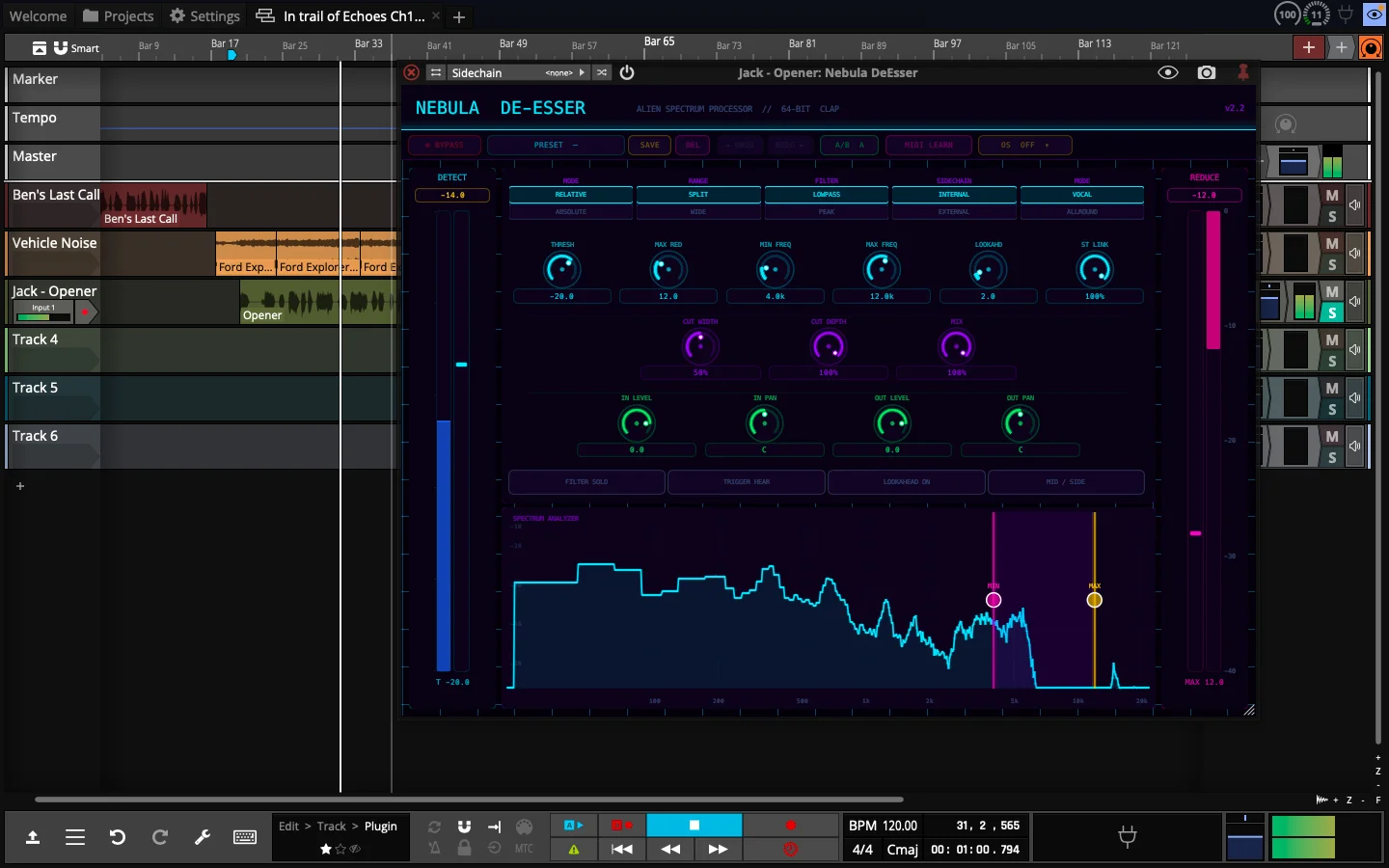
- Live FFT spectrum analyzer with draggable nodes for visually setting detection band min/max frequencies
- Two detection modes (Relative and Absolute) and two processing modes (Vocal and Allround) for flexible de-essing across different sources
- Phase-transparent complementary LP/HP crossover eliminates phase artifacts at the split point
- Adjustable lookahead (0-20 ms), oversampling (1x-8x), and stereo link (0-100%) for precise control over detection and processing
- A/B state comparison, 50-step undo/redo history, and MIDI Learn with context menus
- Filter Solo function isolates the detection band for accurate frequency targeting
Description
Nebula De-Esser by Subhankardas is a 64-bit double-precision de-esser plugin built in Rust, featuring a live FFT spectrum analyzer with draggable nodes for setting detection band boundaries. It succeeds the developer's earlier De-Esser NXT, which required source code compilation and only ran on Windows 11.
The plugin offers two detection modes: Relative (dynamic threshold based on surrounding signal level) and Absolute (fixed threshold). Two processing modes cover different use cases: Vocal mode for speech and singing sibilance, and Allround mode for broader high-frequency taming on any source.
Version 2.2.0 introduced a phase-transparent complementary LP/HP split that eliminates phase artifacts at the crossover point. Three new controls provide fine-tuned shaping: Cut Width adjusts how wide the sibilance cut extends, Cut Depth sets how deep the reduction goes, and Mix blends between processed and dry signal.
Additional features include adjustable lookahead from 0 to 20 ms, oversampling from 1x to 8x, stereo link from 0 to 100%, and a 50-step undo/redo history. A/B state comparison lets you toggle between two configurations instantly.
The interface follows a synthwave aesthetic with resizable windows and persistent sizing. MIDI Learn with context menus and right-click numeric input provide precise parameter control.
Frequently Asked Questions
What is the difference between Relative and Absolute detection modes?
Relative mode sets the detection threshold based on the surrounding signal level, so it adapts dynamically to varying input volumes. Absolute mode uses a fixed threshold, which gives more predictable behavior on consistently-leveled sources like pre-compressed vocals.
What happened to De-Esser NXT?
Nebula De-Esser replaces the discontinued De-Esser NXT. NXT required compiling from source code and only ran on Windows 11. Nebula ships as prebuilt binaries for macOS, Windows, and Linux with a completely redesigned interface and expanded feature set.
Does Nebula De-Esser introduce latency?
The plugin has an adjustable lookahead from 0 to 20 ms. At 0 ms lookahead there is minimal latency, but enabling lookahead introduces a small delay that allows the de-esser to react before sibilance peaks arrive. Typical CPU usage is under 1% per instance.
What is the phase-transparent crossover in version 2.2.0?
Version 2.2.0 replaced the crossover filter with a complementary LP/HP split design that sums back to the original signal without phase artifacts. This means the de-esser only affects the targeted frequency band while leaving the rest of the signal completely untouched.