
Key Features
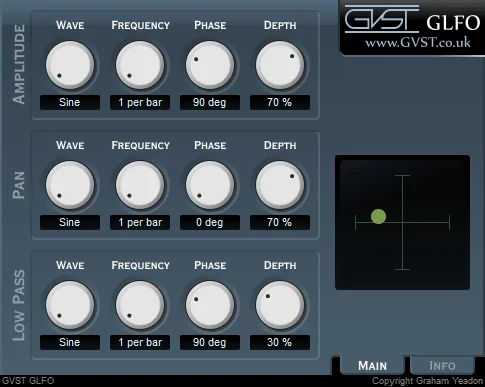
- Modulate amplitude, stereo pan and a low-pass filter with three independent LFOs
- Choose sine, triangle, square, rising, falling or random waveforms
- Set each oscillator’s frequency relative to the host tempo
- Adjust the phase of each wave at the start of a bar
- Set modulation depth separately for each destination
- Visualize the interaction of the three LFO curves
Description
GLFO by GVST is a VST effect that uses three independent low-frequency oscillators to move a signal’s volume, stereo position and low-pass filter. It combines tremolo, panning and filter motion in one interface, with a display showing how the three curves interact.
Each oscillator has its own waveform, frequency, phase and depth controls. Choose from sine, triangle, square, rising, falling and random shapes to change the character of each movement, then set its strength independently.
The oscillator frequencies follow the host tempo, and the phase control sets where the wave starts at the beginning of a bar. GVST notes that tempo information may not be supported by every VST host, so synchronization depends on the software you use.
Combining the three movements can create a spinning impression, while the random shape can introduce less predictable changes to a texture. A Plugins4Free user found its panning useful, but wanted slower cycle options and more control over the filter.
GLFO is designed for a VST host rather than standalone use. GVST provides platform-specific downloads and installation guidance on its website; choose the build that matches your operating system and host.
Frequently Asked Questions
What does GLFO modulate?
GLFO uses three independent LFOs to control amplitude, stereo pan and a low-pass filter. Each has its own waveform, frequency, phase and depth controls.
Does GLFO sync to the tempo of my project?
Its LFO frequencies are tied to the host tempo. GVST notes that some VST hosts may not provide the necessary tempo information.
Can GLFO create random modulation?
Yes. Random is one of six waveform choices, and each LFO can use its own shape.
Does GLFO work without a DAW?
GLFO requires a VST host rather than running as a standalone application. GVST provides installation instructions for different operating systems on its Basics page.


