
ZL Equalizer 2
Key Features
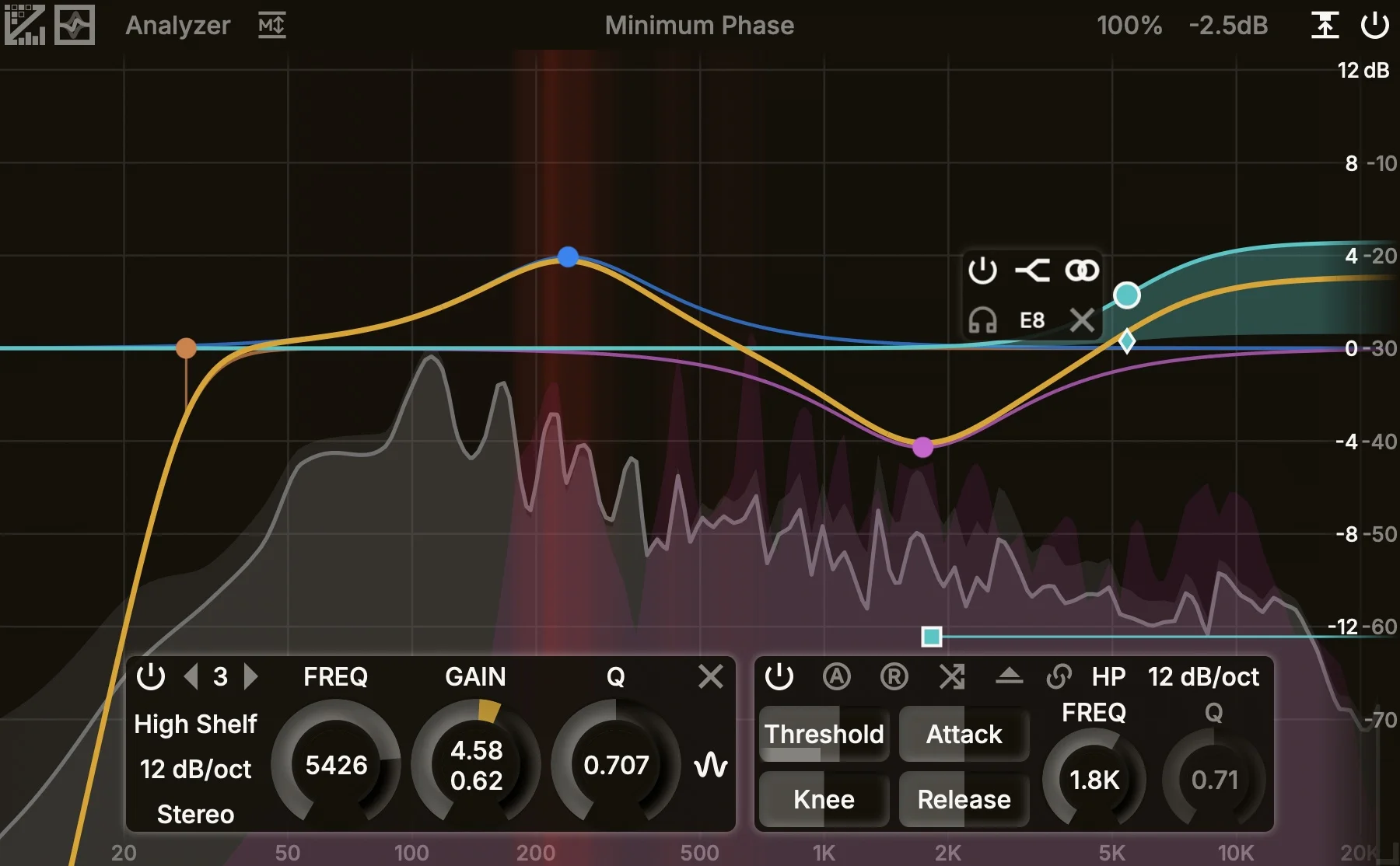
- Up to 24 bands with six filter structures, eight filter types, five stereo placements, and slopes reaching 96 dB/oct give it enough range to act as a full session workhorse instead of a one-task utility.
- Per-band dynamic behavior adds threshold, knee, attack, release, and sidechain-filter control, so the same EQ can move from static shaping into de-essing, resonance control, and frequency-dependent ducking.
- Dynamic Learning and Relative modes help the plugin adapt its trigger behavior to changing material, which makes it more practical on vocals, buses, and evolving sources than a fixed-threshold setup.
- Per-band Stereo, Left, Right, Mid, and Side operation keeps corrective cuts and tonal shaping tightly targeted without reaching for a separate imaging or mastering EQ.
- Built-in collision detection, FFT freezing, and EQ Match extend the analyzer beyond simple display duty, helping you spot masking issues and build quick reference-based curves inside the same interface.
- Minimum, Parallel, Matched, Mixed, and Zero Phase style options let you choose between straightforward everyday EQ moves, analog-leaning behavior, and higher-latency surgical work when phase handling matters.
Description
ZL Equalizer 2 is an open-source dynamic EQ from ZL Audio that covers the modern main-EQ role across mixing and mastering with a fast graph-based workflow, up to 24 bands, and per-band dynamics. The official manual positions it less like a stripped-down freeware utility and more like a deep everyday equalizer with phase options, sidechain-aware dynamic filters, and EQ Match in the same window.
That breadth matters because it can handle routine cuts and boosts, mid/side cleanup, resonance control, and reference matching without forcing you into separate corrective and mastering tools. Six filter structures, five stereo modes, seven slopes up to 96 dB/oct, and relative or learned dynamic behavior make it flexible enough to move from transparent problem-solving to more deliberate tone shaping.
Editorial testing and user feedback line up on the same tradeoff: the feature set is unusually strong for a no-cost EQ, but the workflow is denser than simpler options like TDR Nova and some advanced modes need restraint. Matched Phase and Mixed Phase add useful analog-style behavior, Zero Phase is available for surgical work, and the manual explicitly warns against automating those higher-latency modes.
As checked on April 28, 2026, ZL Audio still distributes version 1.1.0 as a standing free and open-source release through public GitHub installers for macOS, Windows, and Linux, with no signup wall or trial language. The main caveat is trust rather than price: the official README and installation docs still note that the installers are not notarized on macOS and not EV-certified on Windows, so SSA mirrors the standard release files but users should still expect OS security prompts on first install.
Frequently Asked Questions
Is ZL Equalizer 2 more of a main EQ or a problem-solver EQ?
Mostly a main EQ. BPB's 2026 comparison frames TDR Nova as the quicker problem solver for de-essing and reactive resonance work, while ZL Equalizer 2 is the broader everyday choice for cuts, boosts, mid/side shaping, and more complex curves.
Does ZL Equalizer 2 support dynamic EQ and sidechain-style control on its bands?
Yes. The official manual shows dynamic behavior at the band level with threshold, knee, attack, release, and sidechain filter controls, plus Dynamic Learning and Relative modes for more adaptive triggering.
Which phase modes add latency?
According to the official manual, Matched Phase adds about 11 ms of latency, Mixed Phase adds about 21 ms, and Zero Phase adds about 171 ms, with higher totals possible in left/right or mid/side processing. The same manual warns against automating filter parameters in those higher-latency modes.
Is ZL Equalizer 2 still permanently free and open source?
As checked on April 28, 2026, yes. The official installation page still says ZL Equalizer is free and open-source under AGPLv3, and the live GitHub release page exposes public installers for the current 1.1.0 release without any registration or checkout flow.
Will macOS or Windows show security warnings on install?
Possibly. The official README states that the installer is not notarized on macOS and not EV-certified on Windows, so some systems may show Gatekeeper or SmartScreen style prompts the first time you run the installer.


