
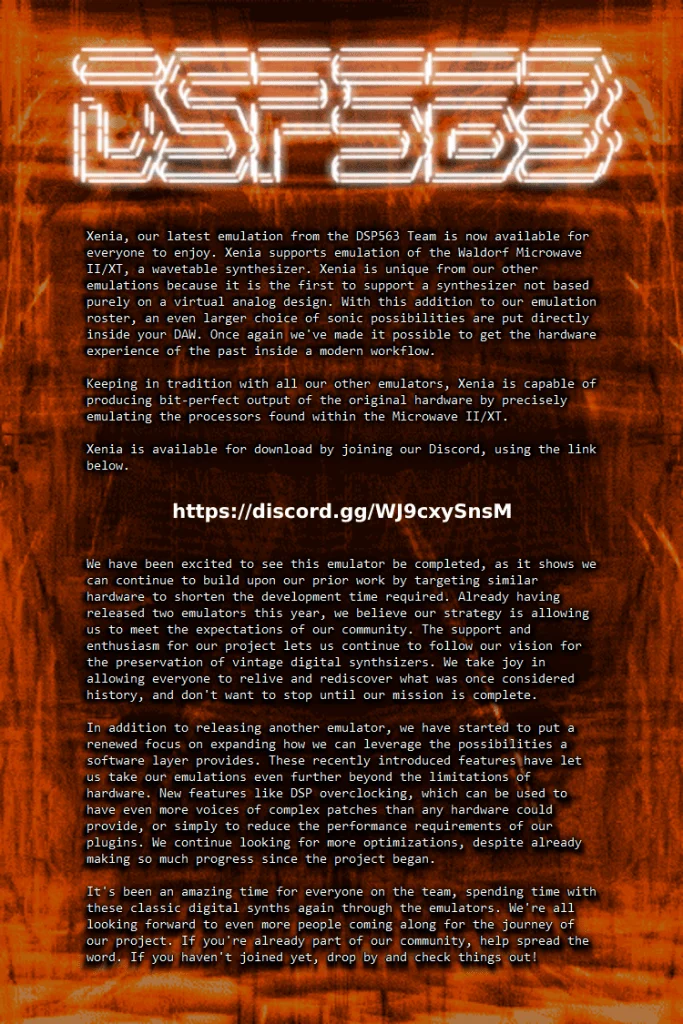
Xenia
Key Features
- Emulates the Waldorf Microwave II and Microwave XT rather than approximating their front-panel styling.
- Uses the DSP56300 project’s low-level approach to run the original hardware architecture in a DAW.
- Targets the Microwave family’s wavetable synthesis and distinctive digital-filter character for evolving, synthetic tones.
- Provides Xenia builds for Windows, macOS, Linux x64, and Linux aarch64 from one developer-controlled download page.
- Supports FST, VST3, AU, CLAP, and LV2 plugin formats in the current Gearmulator project.
- Includes an optional XeniaFX effects variant alongside the instrument downloads.
- Offers modern project updates while preserving the original device’s ROM-dependent workflow.
Description
Xenia is a software emulation of the Waldorf Microwave II and Microwave XT wavetable synthesizers from The Usual Suspects. It runs the original hardware architecture in a DAW, making it a focused choice for the sharp digital colors, animated tables, metallic edges, and shifting pads associated with the late-1990s Microwave family.
Rather than borrowing the look of the hardware alone, Xenia is part of the DSP56300 project and models the device’s Motorola DSP-based design. The current developer release provides a modern plugin shell around that emulation, with a browser and the practical benefits of a software instrument while retaining the original synth’s distinct approach to digital filtering and wavetable movement.
The sound is especially at home in experimental electronic work, tense cinematic layers, and vintage digital leads that should remain recognizably synthetic rather than smooth or analogue-like. It can also be an effective texture source when a production needs motion and unusual harmonic detail without relying on a broad, general-purpose synth.
Xenia is not a turnkey replacement for a modern preset instrument: users must provide a legally obtained Microwave II or XT ROM, which the developer does not distribute. Once that requirement is met, the official download page supplies builds for Windows, macOS, and Linux in current plugin formats.
Frequently Asked Questions
What hardware does Xenia emulate?
Xenia emulates the Waldorf Microwave II and Microwave XT wavetable synthesizers. The developer documents it as a DSP56300-based emulation of the Microwave II/XT architecture rather than a generic wavetable synth inspired by those instruments.
Do I need a ROM to use Xenia?
Yes. Xenia needs a valid Microwave II or XT ROM, and The Usual Suspects do not distribute those firmware files. You need to obtain the ROM legitimately before the emulator can run the corresponding hardware system.
Which plugin formats and operating systems are supported?
The current Gearmulator project lists FST, VST3, AU, CLAP, and LV2 formats. Its Xenia download page supplies Windows, macOS, Linux x64, and Linux aarch64 builds; consult that page for the current installer choices.
Is Xenia the same as a modern all-purpose wavetable synth?
No. Xenia is designed around the behavior and sound architecture of the Microwave II/XT, including its particular digital character and ROM-driven operation. It is best approached as a hardware-faithful instrument for that family’s sound rather than as a blank-slate contemporary synth.


