
Quad Morph Filter
Key Features
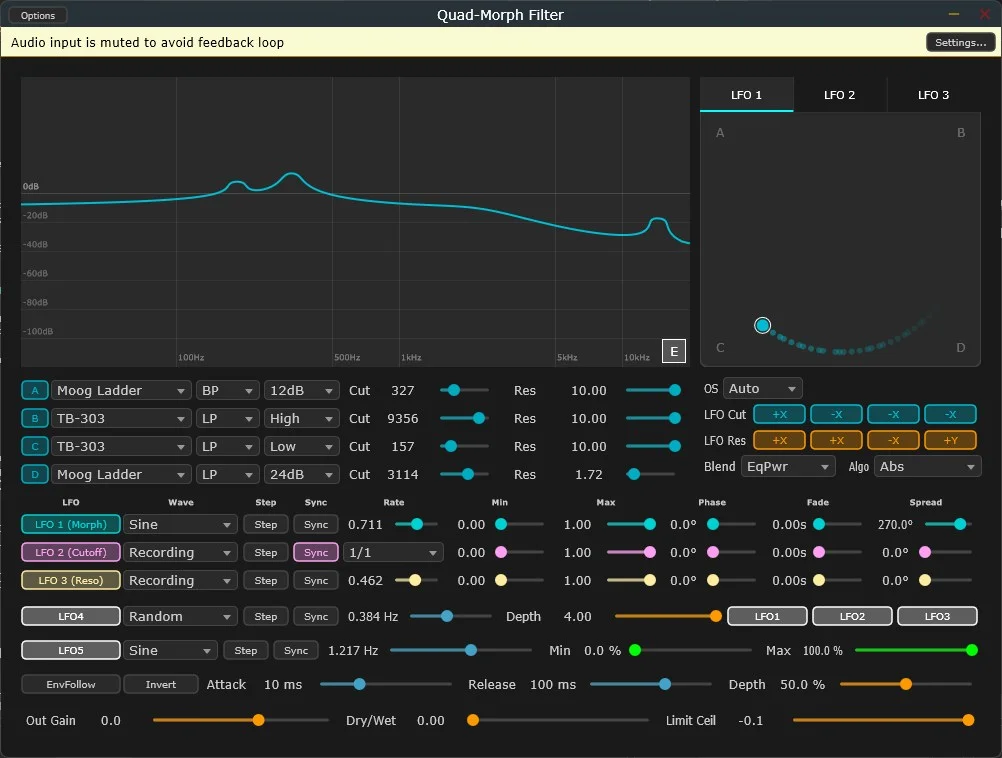
- Morph up to four filter models in real time from an XY pad, using equal-power, linear, smoothstep, or radial blend behavior.
- Twenty-eight included models cover analog ladder and state-variable filters, digital precision filters, formant filtering, comb filtering, wavefolding, modal resonance, Bode shifting, and Z-Plane-style movement.
- Nineteen LFO shapes include classic waves, random and noise movement, geometric curves, chaotic attractors, and a recording mode for hand-drawn XY paths.
- Separate modulation engines can target morph position, cutoff, resonance, LFO rate, and dry/wet range for animated sweeps and complex motion.
- Oversampling, automatic gain compensation on selected resonant models, output gain, a limiter ceiling, parameter smoothing, and a real-time frequency response display help keep aggressive sound design controlled.
- The GitHub release includes both a Windows VST3 bundle and standalone application, with source code distributed under GPLv3.
Description
Quad Morph Filter is a Windows VST3 effect and standalone app built around real-time movement between multiple filter models. Instead of choosing one static low-pass or comb setting, you load up to four models into an XY pad and blend them while the sound is playing.
The core library covers 28 filter models, from familiar Moog, TB-303, SEM, MS-20, CS-80, Prophet, Oberheim, and Jupiter-style circuits to formant, comb, wavefolder, Bode shifter, modal resonator, Z-Plane, phased-array, and digital precision designs. Four blend curves give the morphing different response shapes, and the pad can also switch into direct cutoff and resonance control.
Modulation is the real reason to try it on synths, drums, and experimental sound design. The plugin includes 19 LFO waveforms, tempo sync from 8/1 to 1/64, free-rate operation from 0.01 Hz to 20 Hz, envelope following, dry/wet modulation, and a recording mode for drawing custom XY paths.
The tradeoff is platform scope and gain safety. OTODESK's release is Windows-only, requires an AVX2-capable processor, and includes a clear warning that resonant or experimental settings can produce loud output, so start with low monitoring levels and use the built-in output gain and limiter carefully.
Video Preview


Frequently Asked Questions
Is Quad Morph Filter mainly a mixing filter or a sound-design effect?
It is better treated as a sound-design filter. The XY morphing, chaotic LFO shapes, recording mode, and experimental models are aimed at animated movement rather than simple static tone correction.
What makes the XY pad different from automating cutoff and resonance?
The pad can blend between up to four different filter models, so a movement can travel between separate filter characters instead of only sweeping one cutoff frequency. It can also switch to direct cutoff and resonance control when that simpler workflow is needed.
Why does the page include a loud-output warning?
The official README and release notes warn that resonant and experimental settings can generate loud output. Start at low monitoring levels, watch your meters, and use the output gain and limiter ceiling when exploring aggressive patches.
Does Quad Morph Filter work on macOS or Linux?
The official v1.0.0 release lists Windows 10 and Windows 11 only. The shipped archive contains a Windows x86_64 VST3 bundle, plus the release notes mention a standalone Windows application.


