
Overtonium
Key Features
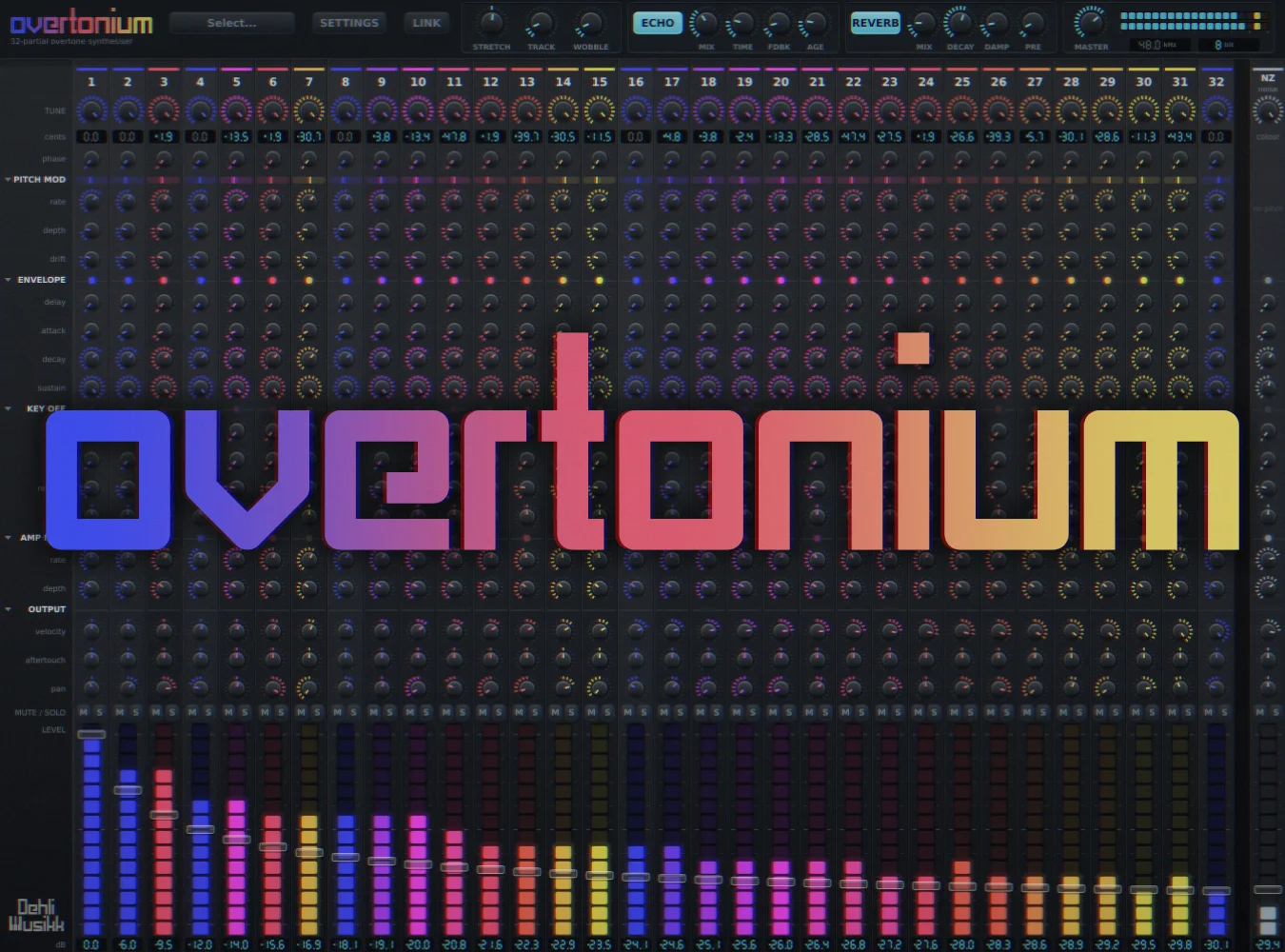
- Mix 32 sine-wave harmonic partials directly with individual faders, pan, mute, solo, and level metering.
- Move partial tuning continuously between just intonation and equal temperament with the central TUNE control.
- Shape each partial with its own envelope, pitch modulation, tremolo, slow drift, velocity response, and pressure response.
- Add a dedicated noise channel with its own envelope, placement, modulation, and color control for non-pitched texture.
- Use inharmonic stretch, keyboard tracking, six historical temperaments, adjustable reference pitch, and MPE for alternative tunings and expression.
- Apply tape echo, feedback-delay-network reverb, global wobble, and render-rate/bit-depth reduction without leaving the instrument.
- Use LINK to edit related partials together and start from 28 supplied presets while saving custom patches locally.
Description
Overtonium is a 32-partial additive synthesizer by Dehli Musikk that presents its sine-wave harmonics as a mixer rather than hiding them behind a spectrum display. Each strip is tied to a harmonic of the note being played, so fader levels, pan, tuning, envelope, modulation, velocity, and pressure can shape a sound partial by partial.
Its standout TUNE control continuously shifts the harmonic series from just intonation toward equal temperament. At one end the partials fuse into a unified timbre; at the other, they move toward semitone positions and can spread into chord-like color.
The instrument also supplies a separate noise channel, per-partial drift and tremolo, inharmonic stretch, keyboard tracking, six historical temperaments, MPE, and LINK editing for moving related channels together. Tape echo, feedback-delay-network reverb, global wobble, and a render-rate/bit-depth converter extend the additive core from clean organ-like structures to unstable, lo-fi textures.
Twenty-eight factory presets demonstrate contrasting starting points including saw-like, bell, electric-piano, choir, and tape-colored sounds. Overtonium runs as VST3, AU, LV2, or standalone software across macOS, Windows, and Linux, with platform-specific installers or archives on the developer's download page.
Frequently Asked Questions
How does Overtonium approach additive synthesis?
It exposes 32 harmonic sine oscillators as individual mixer-style strips. Rather than drawing a spectrum, you set the level and behavior of each partial with its own channel controls.
What does the TUNE control change?
TUNE moves each partial continuously between its equal-tempered position and its exact whole-number harmonic ratio. This can change the same partial setup from a fused timbre into more chord-like harmonic spacing.
Can Overtonium make sounds beyond clean additive tones?
Yes. The noise channel, drift, tremolo, wobble, tape echo, reverb, and render-rate/bit-depth converter can add attack, motion, space, and deliberately degraded character.
Does it support expressive MIDI control?
Yes. The developer documents MPE support with per-note pitch bend and pressure, plus slide routing to brightness or tuning. Individual partials can also respond to velocity and pressure.
Which plugin formats are available on each platform?
macOS includes VST3, Audio Unit, and standalone builds; Windows includes VST3 and standalone; Linux includes VST3, LV2, and standalone. The official install page provides the appropriate installer or zip for each platform.


