
Mango
Key Features
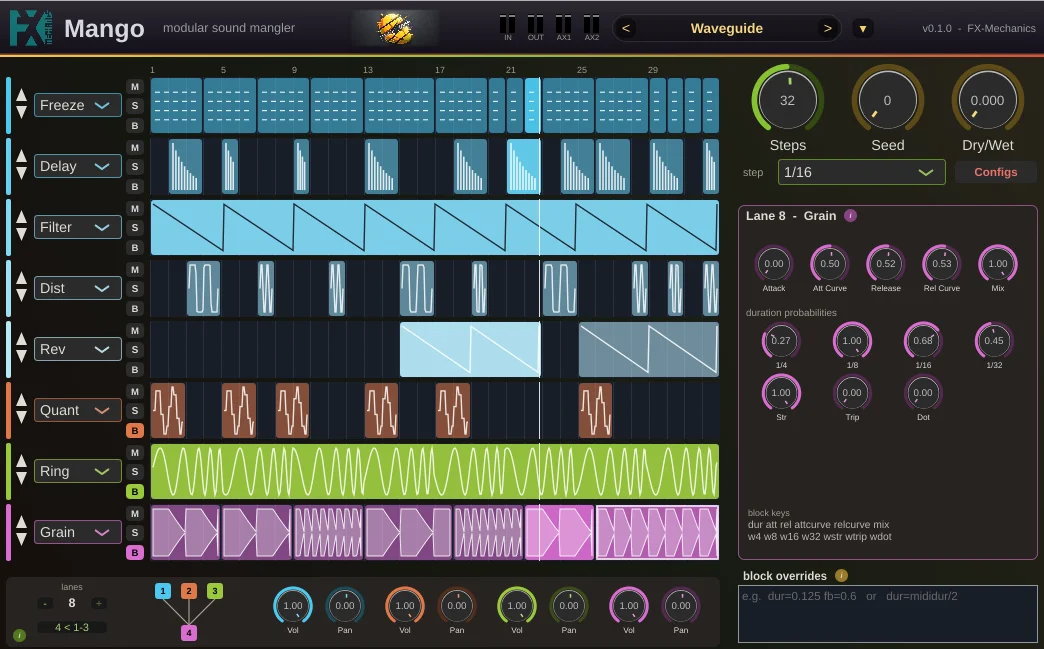
- Up to eight step-sequenced effect lanes for painting exactly when each glitch processor becomes active
- Lane effects cover gater, grain looping, delay, distortion, filter, bit reduction, ring modulation, reverse, spectral freeze, aux send, and panning
- Seeded randomness re-rolls weighted rhythmic choices while preserving repeatable playback for real-time use and offline bounces
- Blocks can be moved, resized, copied, deleted, and retuned with per-block override text for more precise edits
- Parallel and serial bus routing modes let lanes run as stacked chains, split paths, diamond routing, or fan-out structures
- MIDI input can drive pitch-aware parameters such as tuned delay behavior in compatible hosts
- Preset/config slots store complete sequencer patterns, lane order, routing, grid settings, and random seed states
Description
Mango by FX-Mechanics is a modular glitch and sound-mangling effect built around a step sequencer with up to eight effect lanes. You draw blocks onto each lane to decide when processors such as gating, grain looping, delay, distortion, filtering, bit reduction, reverse, spectral freeze, aux send, and panning become active.
The main appeal is that every lane can stack into a timed processing chain while still behaving transparently outside its blocks. That makes Mango useful for turning drums, vocals, synth loops, and full buses into tempo-locked fills, reverses, stutters, frozen washes, and broken rhythmic transitions without cutting the audio by hand.
Mango also leans into deterministic randomness rather than simple fixed-rate sequencing. Duration probabilities and a global seed can re-roll rhythmic choices across the pattern, but the same seed, lane, and block combination plays back identically in real time and offline bounces.
The current GitHub release provides public Windows, macOS, and Linux builds, with VST3 on all three platforms, AU on macOS, and standalone applications where available. It is more technical than a one-button glitch tool, especially because MIDI input and the block override language open deeper pitch-tracked delay and per-block control workflows.
Video Preview

Frequently Asked Questions
Is Mango an instrument or an audio effect?
Mango is an audio effect, so it processes sound that is already passing through the track or bus. It can listen to MIDI notes, but those notes control selected effect parameters rather than generating audio by themselves.
How does Mango's seeded randomness work?
Effects that use rhythmic rates can draw from weighted note-length probabilities instead of one fixed value. The draw is tied to the seed, lane, and block, so the same setup repeats consistently while changing the seed creates a new variation.
What makes Mango different from a simple stutter plugin?
Mango is organized as a lane-based sequencer where several effect types can be stacked, reordered, muted, soloed, and routed through buses. That gives it more arrangement-style control than a single repeat or gate processor.
Why might Mango not appear in a macOS DAW after installation?
The official documentation says the macOS build is unsigned, so browser downloads may be quarantined by macOS. Users may need to clear the quarantine flag or allow the installer through Privacy and Security before rescanning their DAW.


