
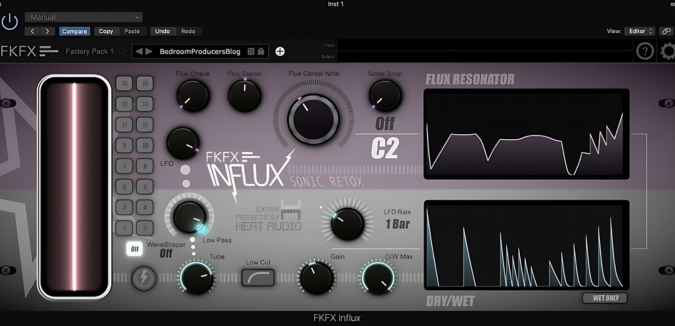
FKFX Influx

Key Features
- FLUX resonator combines resonator behavior with real-time wavetable-style movement.
- Low-pass filtering and tube distortion add tone shaping and harmonic color.
- Dry/wet LFO editing supports rhythmic transformations and signal replacement.
- Scale and root-note controls help keep resonant pitches musical.
- WET ONLY mode outputs the transformed layer without the dry input.
- The current page documents waveshapers, stereo pitch shift, low-cut filtering, MIDI Learn, and preset tools.
Description
FKFX Influx is a real-time sound-mangling effect built around a FLUX resonator, filters, tube distortion, and rhythmically controlled dry/wet movement. It can turn a loop or other input into resonant, pitched, sliced, or chaotic textures, with a WET ONLY mode for replacing the original signal with the transformed layer.
The current FKFX page presents Influx Pro alongside the older Influx version, which remains available for free. The Pro page documents scale snapping, resonator-note editing, stereo pitch shift, waveshapers, low-cut filtering, preset randomization, and MIDI control, but the free legacy edition may not contain every Pro feature.
The source lists Windows 10 and macOS 10.13 or later, 2 GHz CPU, 1 GB memory, and 64-bit VST/VST3 or Audio Unit support for the current plugin family. Use the free legacy download route for this page and check its installer for the exact format set.
Video Preview

Frequently Asked Questions
Is FKFX Influx still available for free?
The FKFX product page says the older Influx version is still available for free. Influx Pro is the expanded paid version, so features on the Pro page should not automatically be assumed to be part of the free legacy build.
What does the FLUX resonator do?
It processes an input loop or sound into resonant, pitched, and animated material. Root-note, scale, modulation, and stereo controls can steer the resulting texture.
What operating systems are listed?
The current FKFX page lists Windows 10 and macOS 10.13 or later, a 2 GHz or faster CPU, and at least 1 GB of memory. It documents 64-bit VST/VST3 and Audio Unit support for the current plugin family.


