
edgeRunner retrograde

Key Features
- Linked tube, transformer, variable-mu, op-amp, and tape-style stages provide a broad analog-color palette instead of a single fixed drive curve.
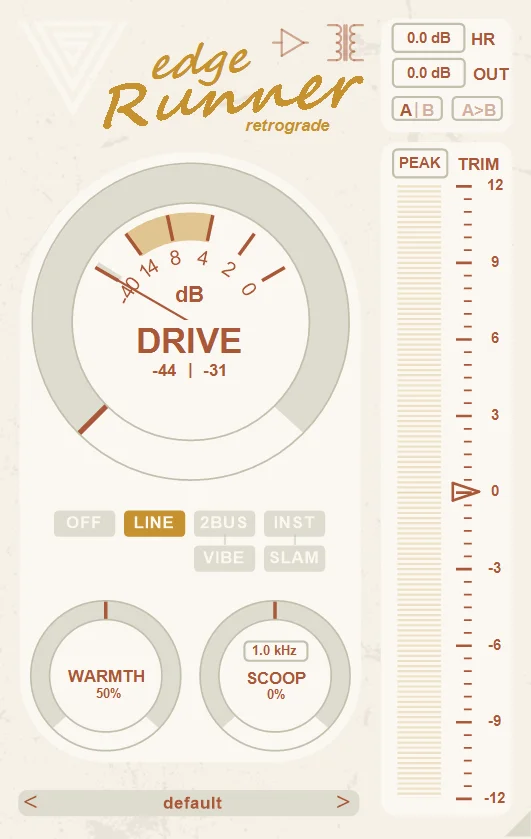
- LINE, 2BUS, VIBE, INST, and SLAM modes move from restrained tonal thickening to more direct saturation and distortion for tracks or stereo material.
- Headroom and DRIVE controls let you set the processing sensitivity and work the internal stages deliberately, with activity metering to guide gain staging.
- WARMTH layers harmonic enhancement, variable-mu-style movement, and tonal/stereo changes, while SCOOP uses compensated pre-emphasis for targeted color shifts.
- The optional op-amp model reacts most audibly to transient-rich signals at higher gain, adding compactness and characteristic high-frequency softening.
- An additional output-transformer option shapes low-frequency dynamics and lower-mid color while generating extra harmonic content.
Description
edgeRunner retrograde is a stereo audio-color processor for adding analog-style depth, density, and character to tracks, buses, and masters. It combines tube amplification, transformer behavior, variable-mu dynamics, op-amp nonlinearities, and tape-like high-frequency compression in one linked processing system.
The five MODE choices cover mild line-amplifier color, balanced stereo-bus processing, more saturated VIBE and SLAM variants, and an INST mode for individual sources. Drive and headroom controls set how hard the internal stages work, while trim and output controls help make honest level-matched comparisons.
WARMTH adds a more complex blend of harmonic, low/high-frequency, stereo, and variable-mu-style movement, while SCOOP applies a compensated pre-emphasis curve before the coloration stages. An optional op-amp model emphasizes transient-rich material at higher levels, and the output-transformer switch adds further low-end dynamic and tonal shaping.
Use edgeRunner retrograde subtly when a source needs warmth and glue, or push it toward dense saturation and intentional destruction for sound design. Variety Of Sound supplies version 1.0 as a Windows VST/VST3 freeware release through its official product page and download flow.
Frequently Asked Questions
What is edgeRunner retrograde designed to do?
It is a stereo processor for audio color grading, combining several analog-inspired nonlinear stages in one workflow. The developer positions it for individual instruments and vocals, mix-bus work, mastering, and stronger artistic effects.
Which mode should I start with?
LINE is the restrained line-amplifier setting, while 2BUS is the balanced option for complex stereo material. INST is aimed at individual tracks, and VIBE or SLAM increase the saturation-and-distortion emphasis of their respective base modes.
How do WARMTH and SCOOP differ?
WARMTH combines several modeled circuit effects, including harmonic changes and variable-mu-style movement. SCOOP is a compensated pre-emphasis equalizer: positive values boost the selected area into the effects stages, while negative values attenuate it.
Can edgeRunner retrograde be used without making a signal obviously distorted?
Yes. The release notes explicitly describe gentle use for texture, warmth, and depth while retaining the source character. More forceful drive settings move toward denser, more aggressive, harmonically complex saturation and distortion.


