
Chow Centaur
Key Features
- Model a Klon Centaur-style guitar overdrive in a plugin.
- Compare Traditional circuit modeling with a Neural gain-stage model.
- Adjust gain, treble and output with a pedal-style interface.
- Bypass the effect to compare the processed and unprocessed signal.
- Choose mono processing in the version 1.4.0 release.
- Explore the published source code and technical paper for details of the modeling.
Description
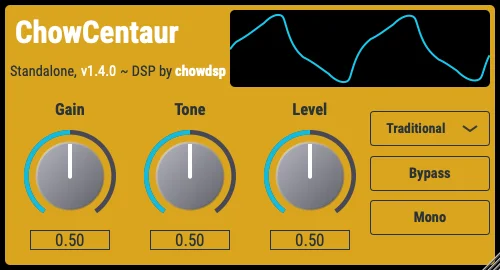
Chow Centaur by Chowdhury DSP is a guitar overdrive plugin modeled on the Klon Centaur pedal. It brings the pedal’s gain, treble and output controls into a DAW, with a bypass switch for comparing the processed and unprocessed signal.
Two selectable models approach the circuit differently: Traditional uses circuit modeling, while Neural uses a recurrent neural network for the gain stage. Switching between them gives guitarists a way to compare the two approaches within the same familiar pedal layout.
Use the gain control to explore the range from a cleaner boost to more pronounced overdrive, then adjust treble and output to suit the rest of the signal chain. Placing the effect before an amp simulator makes it useful for shaping the signal feeding the virtual amplifier, while bypass lets you check its contribution.
The project began as a Stanford class project comparing approaches to circuit modeling, and its developer has published the source code and a technical paper. The desktop release provides Windows, macOS and Linux downloads, and a separate iOS edition is available through the App Store.
Version 1.4.0 adds a mono processing mode and improves performance in both modeling modes. The interface remains focused on the original pedal’s straightforward controls rather than a large collection of effects.
Frequently Asked Questions
What is the difference between Traditional and Neural modes?
Traditional uses circuit modeling techniques. Neural uses a recurrent neural network to model the gain stage of the original circuit.
Can Chow Centaur be used before an amp simulator?
Yes. Place it before an amp simulator in your effects chain to drive and shape the signal entering the virtual amp.
Is the source code available?
Yes. The developer publishes the source under the BSD 3-Clause license, along with links to a technical paper and presentation.


